- Home
- Harz Mountains
- Quedlinburg

Quedlinburg: First Capital of Germany
It would be hard to find a more charming town than Quedlinburg! The narrow, cobblestone streets are lined with over 1300 half-timbered houses.
Here are some tips on the most interesting things to see and do in this well-preserved, historic town.
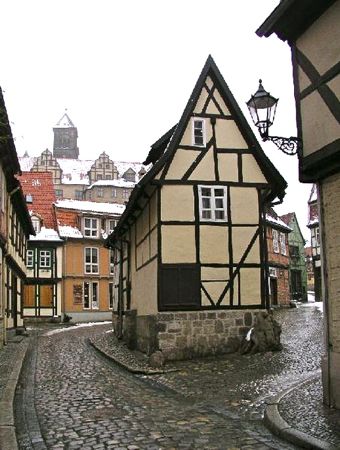 Finkenherd House, in winter.
(Image thanks to Fk, CC-by-SA license.)
Fortunately, the town survived the war undamaged and was valued by the DDR, and so it's still here to be appreciated with its medieval look and layout intact.
As a result, the entire town was named a UNESCO World Heritage site.
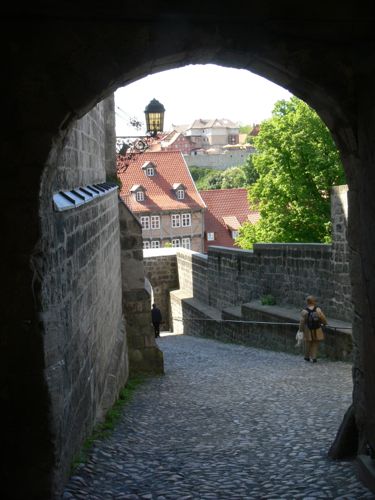 Quedlinburg Castle Gateway
(Image thanks to Fingalo Christian Bickel, CC-by-SA license.)
History of Quedlinburg
Birthplace of the German Nation
King Heinrich I (Henry the Fowler) was crowned King of Germany here in 919 A.D. This was the first time anyone had ruled Germany as a single entity. The church, Norbertinerkirche, was built around this time.
Like other towns of the Harz, it owed much of its prosperity to the silver, copper and tin mines nearby.
It was also a major market town and member of the Hanseatic League, rivaling Cologne in importance during the Middle Ages. The Rathaus was built in 1320.
Women Rule
This town was ruled by women for 800 years. King Heinrich I's widow, Mathilde, founded a convent for aristocratic women in 936 and their granddaughter became the ruler of the town as the Abbess in 966.
The Abbesses of the convent ruled the city until 1802, when Napoleon invaded and disbanded the Abbey.
First Woman Doctor
Maybe it's no coincidence that the first German woman to win the right to attend a university was a native of Quedlinburg. Dorothea Erxleben was the first woman to receive the academic title of Medical Doctor in Germany in 1754.
Post WW2 in Quedlinburg
The half-timbered towns in East Germany got a bit shabby during the DDR days, but it did give them a more authentic, less touristy appearance.
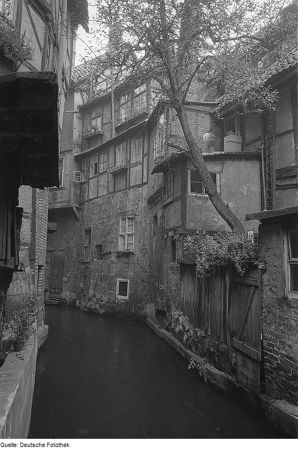 Quedlinburg in the postwar period.
(Image thanks to Deutsche Fotothek, CC-by-SA license.)
What to see in Quedlinburg
The ancient town is built around a large square (Markt) and perches on two hills with the river Bode running through the middle. On one hill is the castle/abbey/church complex called the Burgberg. The other hill is the Muenzenberg.
The Markt
The town square is lined with great examples of medieval and Renaissance buildings. Several large, old hotels are here along with the Rathaus.
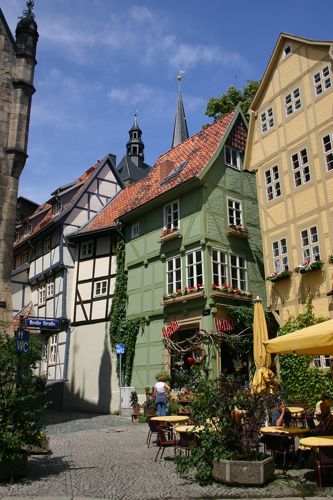 Cafe on the Markt
Breite Strasse, which heads north out of the Markt, has some delightful examples of half-timbered houses.
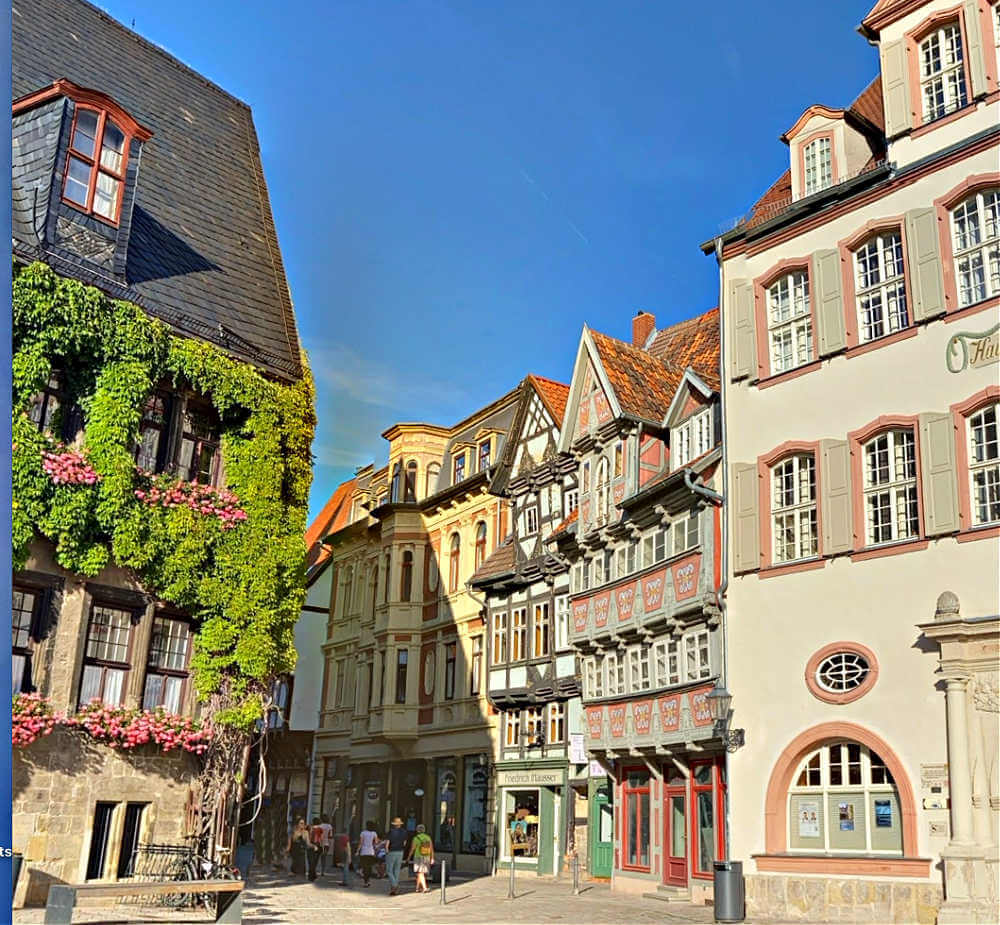 Breite Strasse in Quedlinburg
Make sure you take a walk along this street. Look for Breite Strasse 53, possibly the prettiest of the houses in town.
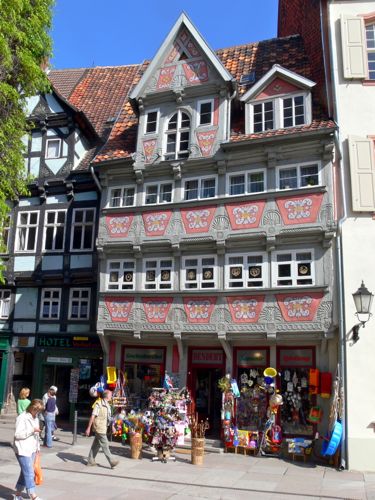 Breite Strasse 53
(Image thanks to Fingalo Christian Bickel, CC-by-SA license.)
Historical Views of Quedlinburg
Here are some images of Quedlinburg in times past. The view of Breite Strasse in 1900 looks a bit shabby but maybe that was the photograph.y
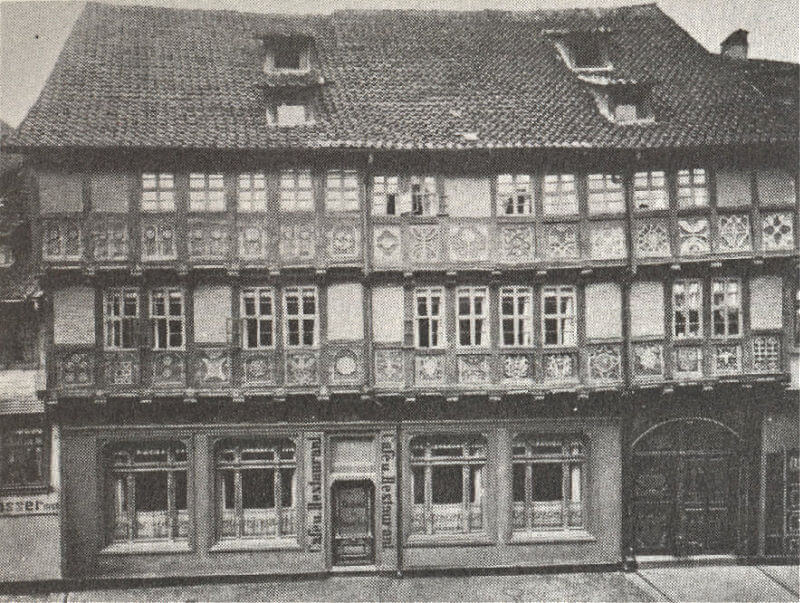 Breite Strasse 39, Gildehaus zur Rose
The Gildehaus zur Rose at #39 Breite Strasse is still there, but the upper stories are a rich red now.
Early drawings of the town of Quedlinburg:
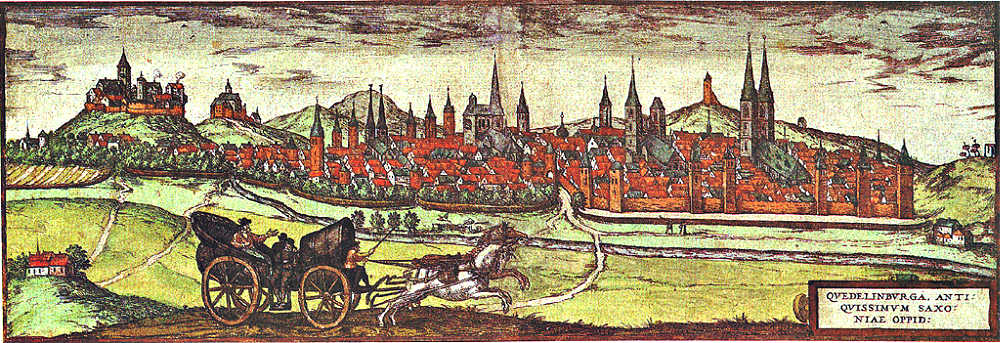 Quedlinburg in 1581
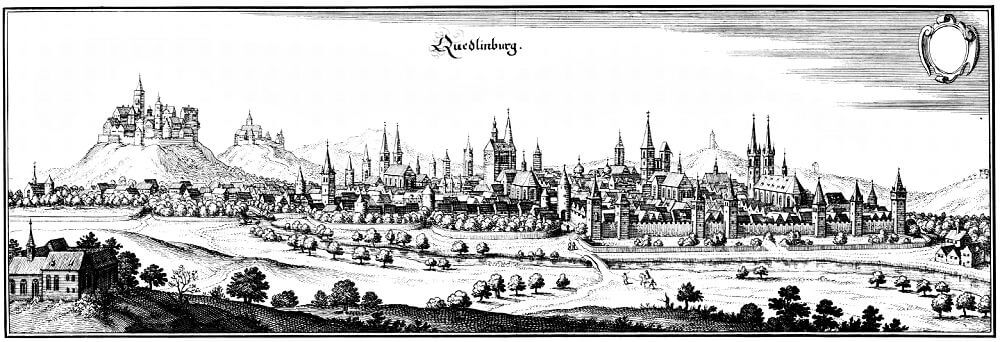 Quedlinburg in 1647
The Burgberg
On the Burgberg ("castle mountain"), or Schlossberg, you will find the Abbesses' Palace (Residenzbau) and the Stiftkirche St. Servatius church.
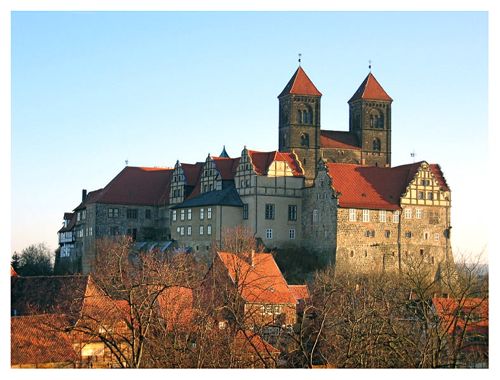 The Burgberg
(Image thanks to APreussler, CC-by-SA license.)
Inside the Abbesses' Palace is the Schloss Museum which displays an interesting assortment of Ice Age fossils, Bronze Age artifacts and medieval torture instruments. On exhibit is the cage used to display a captured robber baron in the 1300's.
St. Servatius, the abbey church, is one of the best-preserved 12th century buildings in Germany. Heinrich I (the Fowler) and Mathilde are buried in the crypt with the abbesses.
The Quedlinburg Treasure
The church also contains the amazing Treasure of Quedlinburg.
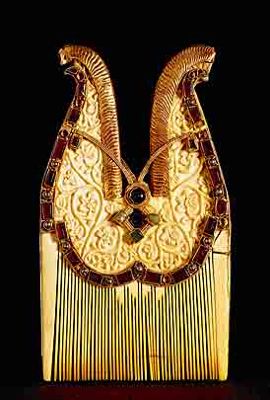 Jeweled Comb, 7th Century
This gorgeous collection of golden chests, religious manuscripts, crystal bottles, ivory combs, and swords, many of which were encrusted with jewels, dates from the 10th, 11th and 12th centuries and has a rocky history.
The treasure took a long leave of absence from Quedlinburg after the second World War (more on that below!).
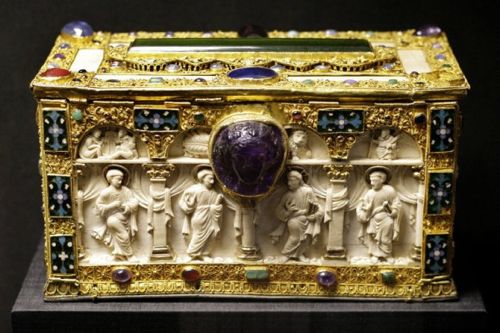 13th Century Reliquary
You can also see the oldest tapestry in Northern Europe, woven around 1200 A.D., with a surprisingly classical theme, the "marriage" of Mercury and Philosophy.
During the war, Heinrich Himmler turned the church into a shrine to the SS, inspired by the church's connection with the first king of Germany, Heinrich I.
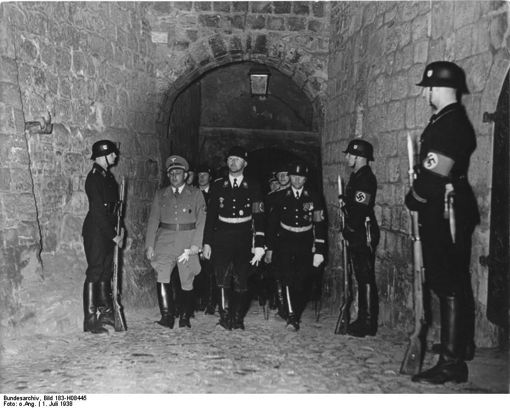 Heinrich Himmler at SS ceremony, Burgberg
(Bundesarchiv, Bild 101III-Bueschel-056-13 / Büschel, CC-by-SA license.)
American Lieutenant Absconds with Treasure
Unfortunately, a 29 year old American officer made off with a good part of the treasure in 1945. During the war, the treasure had been hidden in a mine shaft outside of town for safe-keeping.
The lieutenant was with a unit occupying the town and was supposed to be guarding it. Instead, it "disappeared".
In 1989, one of the jewel-encrusted manuscripts showed up at an antique dealer's in Switzerland. Then another manuscript went on the market in 1990.
Treasure Discovered in Texas
The lieutenant had shipped the priceless artifacts to his parents house in Whitewright, Texas. He went to work in the family hardware store and no more was heard of the treasure until after his death in 1980. His brother and sister, as his heirs, ended up with it and started selling parts of it.
Eventually, a German investigator traced the treasure to a bank vault in Whitewright. After a legal battle, and a $2.75 million settlement, the treasure was returned to Quedlinburg in 1992, where you can see it in the Schloss Museum.
Two pieces are still missing. One of the recovered items was the beautiful, jewel-encrusted ivory comb from the 7th century!
Fate of the Siblings
What happened to the greedy brother and sister? In the end, not much. Felony charges were filed by the U.S. government, but were dismissed because of the Texas statute of limitations.
Then the Internal Revenue Service went after them and levied huge fines, but the pair only ended up paying $135,000.
The Oldest House in Germany
The oldest half-timbered house in Germany, built around 1300, is at Wordgasse 3.
It is now a museum illustrating the history and technique of this style of building (Fachwerkmuseum Staenderbau). Closed Mondays and Tuesdays.
Home of Germany's Milton
One of the greatest masters of German lyric poetry was Friedrich Gottlieb Klopstock, who grew up in Quedlinburg.
His house is at #12 Schlossberg Strasse and is now a museum about his life and work. The museum also has a section on the life of Frau Doktor Erxleben.
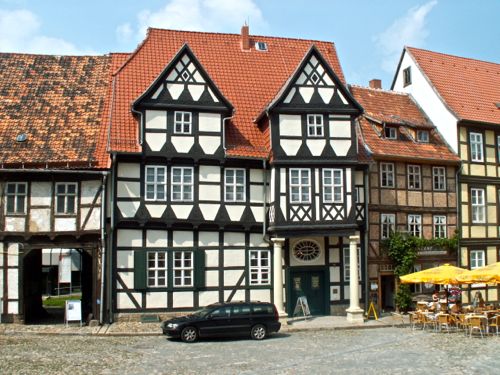 Klopstock's House
(Image thanks to Michael Mertens, CC-by-SA license.)
Klopstock's poetry created a major shift in the style of German poetry in the 18th century. Formal, stylized poems gave way to highly emotional expressions of human feelings.
His themes often emphasize the pleasures of life's small moments in the company of friends and the beauty of nature.
He is also famous for his epic poem, Der Messias, based on the life of Jesus.
Click on Klopstock for a sample of his poetry and more about his life.
For Fans of Bauhaus Art
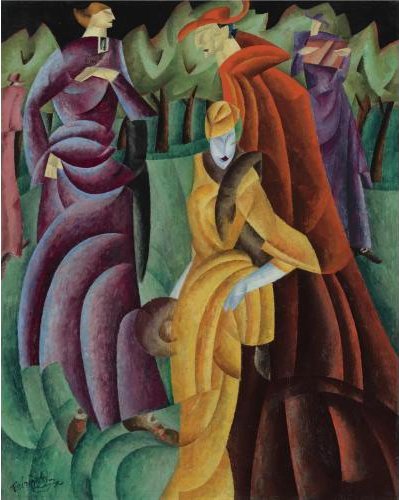 Jesuits III, 1915
Behind the fachwerk houses at Finkenherd 5a is a newer building housing a large collection of Lyonel Feininger's prints, paintings and sculptures.
He was a German-American Bauhaus artist whose cubist works were included in exhibitions of "degenerate art" by the Third Reich in 1936 and 1937.
See more information on Lyonel Feininger and view a gallery of his paintings.
Great View of the Old Town
If you walk up the other hill, the Muenzenberg (west of the Burgberg) you'll get a wonderful view of the castle and red roofs of the town below.
The winding street climbing up there has lots of charming little houses and fewer people.
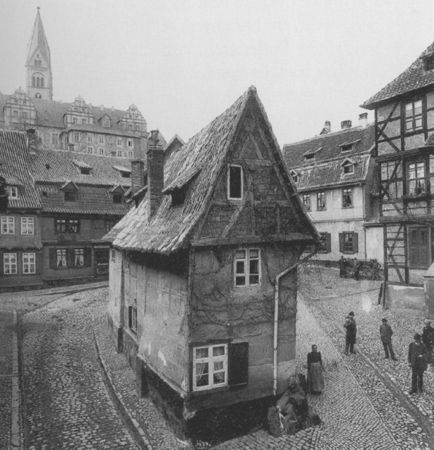 Finkenherd House, 1900
Riding the Steam Trains
The Harz has a network of narrow gauge steam trains that connect some of the towns and can take visitors all the way to the top of the Brocken, favorite mountain of the local witches.
Quedlinburg is one of the stops. See steam train map.
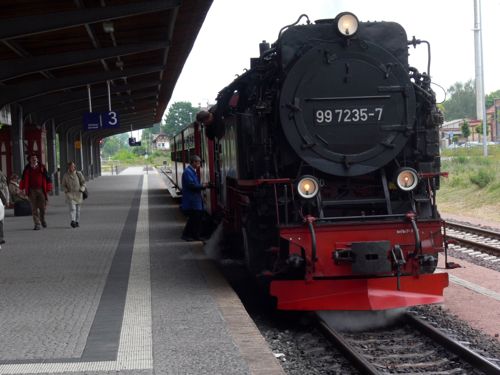 Steam Train in the Quedlinburg Station
(Image thanks to Christian Bickel, CC-by-SA license.)
Visiting Quedlinburg
Arrival at the Bahnhof
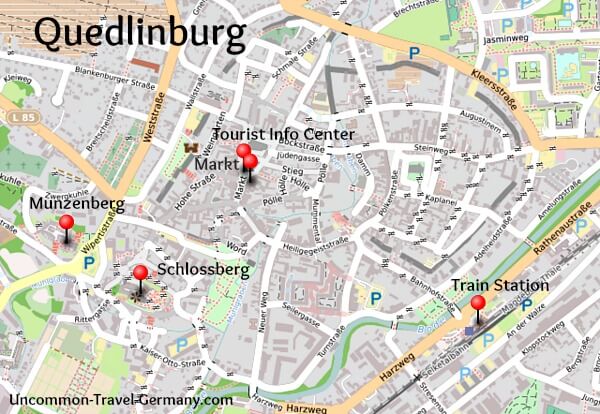
The Bahnhof and bus station are on the east edge of town and the Altstadt (where the Markt is) is just a 10 minute walk, first down Bahnhofstrasse, then left on Heiligengeiststrasse.
The two hills (Burgberg and Muenzenberg) are at the south end of town. See map of Quedlinburg at the bottom.
Tourist Office
The Tourist Office is located on the Markt at #2. This is a good first stop to get a town map and make hotel reservations if you need them.
There is a variety of places to stay, from fancy hotels, reasonable pensions, rooms in homes and a youth hostel. The Tourist Office is open daily Apr-Sept, closed Sundays in winter. (www.quedlinburg-info.de)
Highly-rated Quedlinburg Hotels in the Old Town
More expensive: check out prices and availability below.
- Hotel Theophano (1668) at Markt 13-14 (Hotel Theophano).
- Hotel zum Bär at Markt 8-9 (Hotel zum Bär).
- Hotel Schlossmühle at Kaiser-Otto-Strasse 28. (Hotel Schlossmühle)
- Hotel zum Brauhaus at Carl-Ritter Strasse 1 (Hotel zum Brauhaus).
Less expensive:
- Hotel garni Am Dippeplatz at Breite Strasse 16. (Hotel Am Dippeplatz)
- Urlaub im Fachwerk - Klink at Klink 3-6. Apartment with kitchen in half-timbered building. Very quaint, excellent rating. (Urlaub im Fachwerk).
Where to Eat
The hotels mentioned above are also good choices for a meal. In addition, the following restaurants are tasty spots:
- Zur Roland: charming restaurant that fills up 7 old houses on Breite Strasse 2-8.
- Boulevard Cafe: Sit outside on the Markt and watch the people while enjoying the pastries, at Markt 1.
- Brauhaus Lüdde: Home-brew with your food, at Blasiistrasse 14.
The center of Quedlinburg (the Markt) is about a ten minute walk from the Bahnhof and bus station.
Map of Quedlinburg
For tips on how to get to Quedlinburg, or other towns in the Harz, see travel to the Harz.
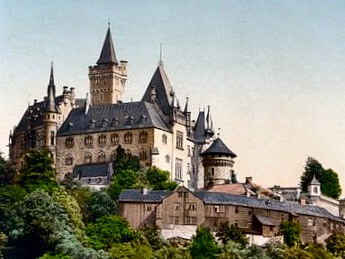
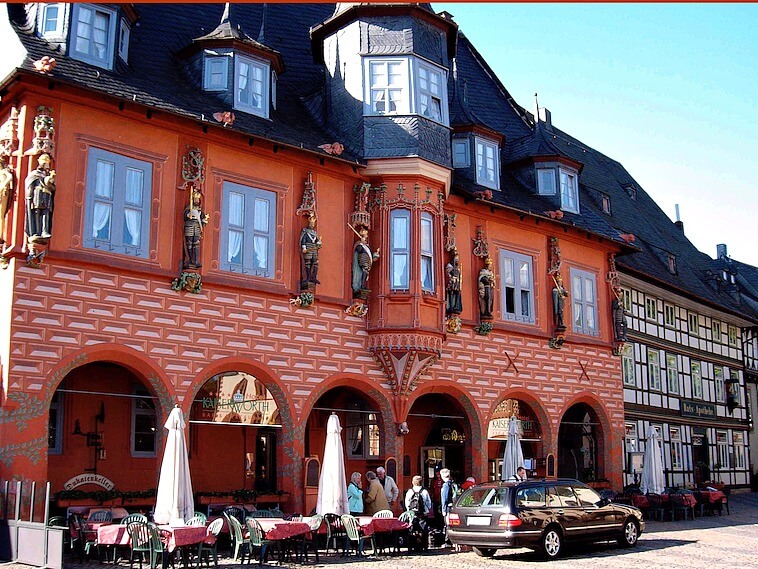
Explore the Harz Region...
Traveling in Germany

Check the German Rail website (Deutschebahn) for train and bus schedules, prices, and ticket bookings.
The last remaining Covid restrictions in Germany, in terms of vaccination and masking requirements, ended April 7, 2023.
See current Covid rules for more information.
Use Policy Affiliate Disclosure
As an Amazon Associate I earn from qualifying purchases.
Uncommon-Travel-Germany.com
Copyright © 2007-. All rights reserved.